
Macfarlanes tops the City on profitability with a 56% margin, as a mix of elite, mid-market and international firms dominate the top ten when ranked by profit rather than size.
Strip away revenue thresholds and specialist firms outperform everyone, with litigation boutiques and focused practices posting the highest margins.
New data looks beyond headline revenue and PEP figures to examine which law firms are the best at turning income into profit.
Leading legal industry consultant Adil Taha of Taha & Co has analysed the top 200 UK firms by profit margin. Using that data, Non-Billable has identified the ten most profitable City firms - based on profit margin - applying two filters: firms must be full service and rank in the UK top 75 by revenue.
The most profitable City firms
At the top of the table sits Macfarlanes, with a standout profit margin of 56%, underlining its long-standing reputation as one of the most efficient operators in the City. Fladgate follows on 51%, a striking result for a firm that has intentionally doubled down on focus rather than scale.
Fieldfisher ranks third on 43%, ahead of Addleshaw Goddard on 42%, showing that strong profitability is not confined to the traditional Magic Circle or US elite. Hogan Lovells and Clifford Chance are level on 40%, putting two of the largest global platforms in the market firmly in the top tier on margins.
Wedlake Bell, A&O Shearman and Taylor Wessing follow closely on 39%, with HFW just behind on 38%.
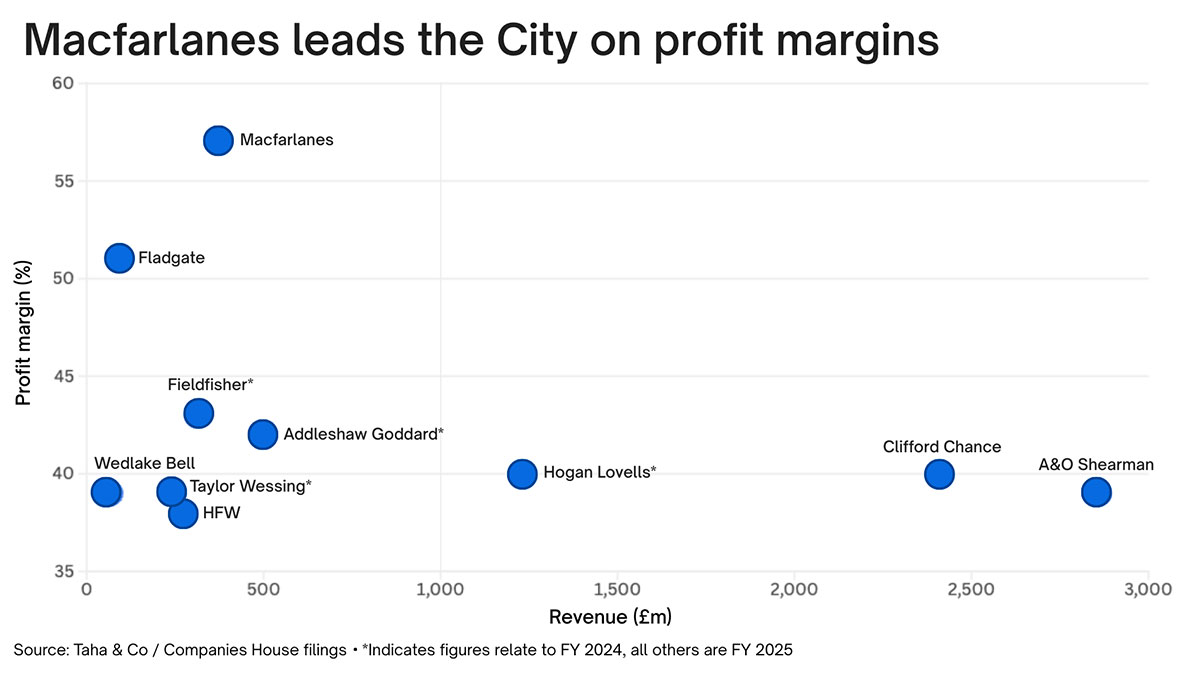
Taha says the common thread among the top City performers is tight cost control and pricing discipline. “These firms have managed the pace of salary growth far better than the rest of the market, while pricing work more effectively,” he says, adding that better lock-up and credit control have also driven stronger cashflow. That, in turn, allows firms to reinvest in talent, reinforcing a strong cycle of performance.
Taken together, the list challenges the idea that profitability inevitably declines as firms get larger - but it also shows how rare truly elite margins are among the UK’s biggest players. For context, at the very top end of the US market, the likes of Kirkland and Latham are often reported to post margins in the 50-60% range.
What else stands out
Ignore the revenue and practice breadth filters, and litigation boutiques dominate the profitability rankings. Firms such as Enyo Law, Stewarts and PCB Byrne post profit margins north of 55%. The data reinforces how focused specialist practices, with lean cost bases and premium pricing, can outperform even the most successful full-service firms on margins.
Other specialists also stand out. Pensions boutique Sackers, long regarded as an outlier for profitability, records a profit margin of 51% in Taha’s analysis, placing it comfortably alongside the most profitable City firms despite its narrower focus.
A bifurcated market
At the other end of the spectrum, Taha says the data points to an increasingly bifurcated market. The smallest 50 firms in the top 200 post average margins of around 25%, with roughly half of their revenue absorbed by staff costs alone, before offices, insurance or partner pay are factored in. “That’s why interest on client accounts is playing such a big role in topping up profits,” he says.
Taylor Rose is a case in point. The firm’s latest accounts show that a substantial proportion of reported profit was generated from interest earned on client accounts, rather than legal fee income. Once that interest is removed, underlying profitability was close to zero.
The result, Taha argues, is effectively two legal markets operating in parallel: one where larger firms and a handful of highly competitive boutiques are capturing high-quality corporate, private equity and litigation work - and another, made up largely of firms below £50 million in revenue, that appears “increasingly distressed”.
Join 10,000+ City law professionals who start their day with our newsletter.
The essential read for commercially aware lawyers.