'Wordsmith' dispute pits $100m legal AI startup against London law firm
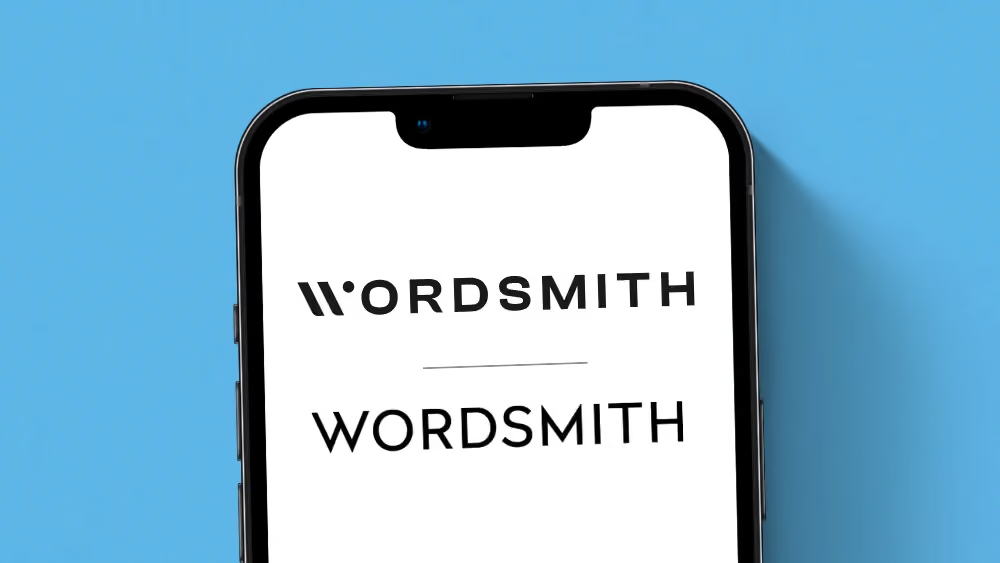
London law firm Wordsmith Law has issued proceedings against legal tech company Wordsmith AI in a dispute presumed to centre on trademark rights.
The case could test how courts view the overlap between AI-powered legal tools and traditional legal services.
An apparent naming dispute between legal AI company Wordsmith and London law firm Wordsmith Law is heating up. While details remain limited, the claim, filed in the Intellectual Property Enterprise Court, is assumed to relate to trademark rights, given the similarity in the parties’ names and their filing history.
Court records show Wordsmith Law LLP as claimant, represented by Waterfront Law, with Wordsmith AI Ltd named as defendant and represented by DAC Beachcroft.
What happened
The Scotland-based AI company, valued at $100 million as of last June, attempted to register a Class 42 trademark covering its AI services in May 2025, but the application was later withdrawn.
Oliver Fairhurst, IP and media partner at Lewis Silkin, said: “A withdrawn application usually signals that someone has threatened to oppose it. In this case, it appears Wordsmith Law may have threatened to oppose Wordsmith AI’s application and it was withdrawn.”
Wordsmith Law already owns a trademark for legal services, and in December 2025 following the AI company’s withdrawn application, filed for a broader trademark covering AI software for use in the provision of legal services, which is currently under examination.
Blurring lines
The dispute would raise new questions for courts that have yet to be tested.
Fairhurst said: “The question is how similar what Wordsmith AI does is to “legal services” - not in the traditional sense, but you can get legal documents from it, which overlaps with what law firms do.
I imagine when you search google for ‘wordsmith’ you might be trying to reach the law firm or the AI company, or you’re not sure which you’re trying to reach, and it becomes a battle for who sits at the top of the search results.”
That distinction will matter if the court is asked to assess whether AI-powered tools fall within the same commercial space as regulated legal services for trademark purposes.
Wrinkles in the system
Trademark law in the UK generally operates on a first-to-file basis, but intention to use the mark and earlier unregistered rights can come into play.
Fairhurst said: “You have to intend to use the trademark. It’s normally a first-to-file system, but there are wrinkles around it.”
In this case, key questions include whether Wordsmith Law really intended to use the trade mark, whether Wordsmith AI has unregistered rights in the name, and whether the most recent trademark filing was made in bad faith.
“If the most recent trademark filed was in bad faith, Wordsmith AI can oppose it and claim the company had earlier rights,” said Fairhurst.
Brand due diligence
The case also raises broader issues around brand clearance in the legal tech sector.
Fairhurst said: “I would have thought Wordsmith AI would have done a trademark clearance search before using the name and obtaining funding because having a brand you can use is pretty important. Even if they did, it’s a reminder for others.”
He added: “This isn’t about the actual service, it’s an issue about whether they can provide those services under the name and, there’s always the question of how much brand clearance did someone do before their starting their business, and maybe they did, but also people are human.”
What happens next
“The most likely scenario is some kind of settlement or a rebrand, or an agreement of coexistence. The case either gets settled, or it will go to trial and the court will have to decide if AI services are similar to legal services, and whether there’s an infringement or not for this trademark,” said Fairhurst.
The case has only just been issued, but if the case does proceed, the timetable could stretch well into next year.
Courts have historically shown little sympathy where infringement is established.Fairhurst said: “Timelines for a rebrand after a judgment can be short - the court has been pretty unsympathetic to businesses found to infringe.”
Wordsmith Law declined to comment and Wordsmith AI could not be reached for comment.
Join 10,000+ City law professionals who start their day with our newsletter.
The essential read for commercially aware lawyers.