The National Pro Bono Centre says more businesses are embedding pro bono into their legal functions as in-house teams develop structured programmes.
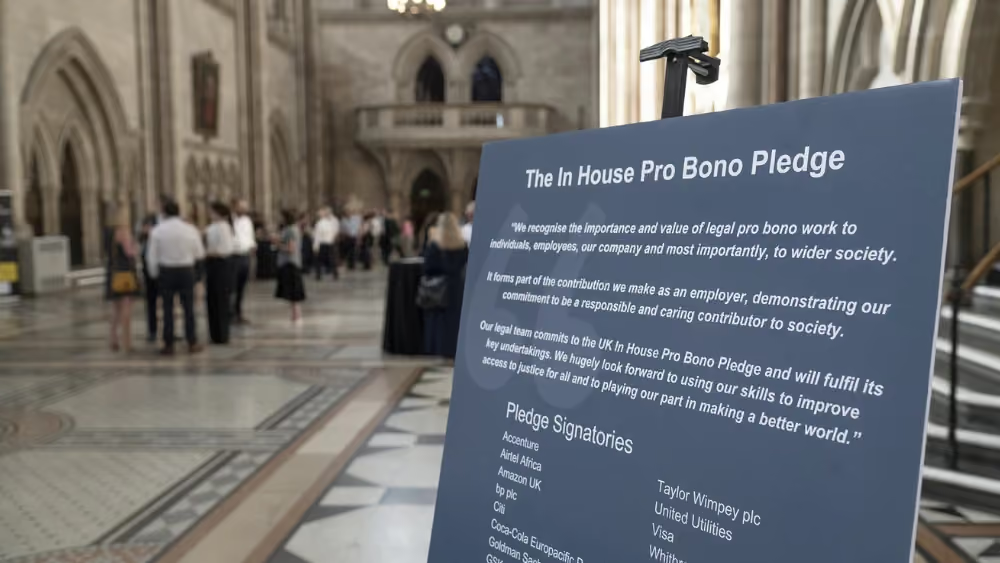
Launched in April 2024, the In House Pro Bono Pledge has attracted legal teams from companies including Amazon UK, HSBC, Goldman Sachs, Visa and IHG Hotels & Resorts.
In-house legal teams are taking a more prominent role in the UK's pro bono landscape, with major companies building formal programmes and increasingly working alongside their external law firms to provide free legal advice.
The trend is reflected in this year's Pro Bono Recognition List, which saw a 40% increase in the number of in-house lawyers recognised for their contributions.
Launched in April 2024, the In House Pro Bono Pledge encourages companies to build structured pro bono programmes and integrate them into their legal functions. Signatories include Amazon UK, HSBC, Goldman Sachs, Visa and IHG Hotels & Resorts.
While pro bono has long been led by law firms, corporate legal departments are increasingly building programmes of their own.
Taking it in-house
The National Pro Bono Centre (NPBC), the UK charity behind the pledge, says the shift is being driven both by private practice lawyers who want to continue pro bono work after moving in-house and businesses increasingly recognising its value.
Mary Dobson Smith, lead consultant on in-house pro bono at the NPBC, said: "These days, lawyers moving from private practice into in-house roles often bring with them a strong commitment to pro bono from volunteering in law school clinics through to taking part in well-established programmes at their firms.
“They want to continue giving back and, most importantly, use their legal skills to help those who need them most."
Dobson Smith said organisations are increasingly recognising that pro bono can support both access to justice and broader business objectives.
"We're seeing that commitment translate into real momentum. More organisations are signing the In House Pro Bono Pledge each year, recognising the value that pro bono brings not only to access to justice, but also to their people, their culture and their wider purpose."
A shared commitment
Sir Robin Knowles, a Commercial Court judge and chairman of the NPBC, said the increasing participation of in-house legal teams reinforces the idea that pro bono should be viewed as a core part of legal practice rather than an activity confined to law firms.
"There is something everyone can do. We have this phrase now that pro bono is part of being a lawyer. And the leadership being shown by the in-house sector brings that home. It's encouragement to everybody in the rest of the sector to step up."
Knowles said the growing involvement of businesses is also creating new opportunities for collaboration between clients and their external legal advisers.
"If major business organisations are able to say to the firms they work with, 'We respect and value what you're doing in pro bono. In fact, at times we would love to do some pro bono work jointly with you,' that's a form of absolutely appropriate and worthwhile encouragement for firms. But of course, first and foremost, it's there for those who need the help."
He added that shared pro bono work can strengthen relationships between businesses and their advisers beyond purely commercial matters.
"And when it comes to the area of work between the law firm and the business, which might be purely commercial, they know that there's a shared set of values and an approach to the law that has points of connection."
From pledge to practice
One organisation putting that into practice is FTSE 100-listed IHG Hotels & Resorts, which signed the pledge two years ago and is now developing a UK pro bono programme as part of its broader responsible business strategy.
David Connolly, head of legal, compliance and litigation for Europe and IMEA at IHG, said the business had no formal UK programme before signing the pledge.
He said the pledge provided both a practical framework for getting started and access to a network of organisations with experience running pro bono programmes.
"It has a network that you can easily plug into. People from different organisations within the network are incredibly helpful, collaborative and supportive.”
Beyond helping IHG establish its own programme, Connolly said the pledge has prompted new conversations with the company's external law firms about working together on pro bono matters.
"One aspect of the pledge for in-house signees is having conversations with your external legal providers about what they're doing around pro bono work."
"It provides a really helpful lens to frame that conversation with your external law firms. And it has opened our eyes to working with our external counsel in that way.”
Join 10,000+ City law professionals who start their day with our newsletter.
The essential read for commercially aware lawyers.