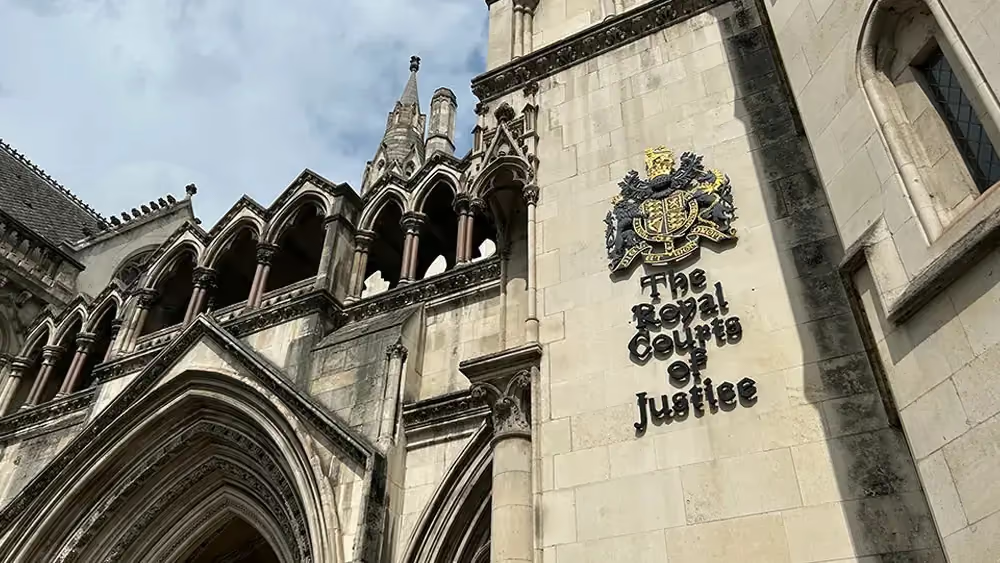
The Chartered Institute of Legal Executives' appeal against the Mazur High Court decision regarding unauthorised legal practitioners and litigation has been upheld.
The decision means that non-solicitors and barristers can go back to handling litigation activities the way they did before the September 2025 ruling.
In a closely watched decision, the Court of Appeal has overturned a High Court ruling that cast doubt over how law firms use non-solicitors in litigation, handing a win to the Chartered Institute of Legal Executives (CILEX) and bringing clarity to an area of uncertainty.
At the centre of the case was whether an unauthorised legal professional, including paralegals, trainees and legal executives, can carry out certain litigation tasks under supervision.
The High Court had previously said no, ruling that a debt recovery order issued by Brighton County Court was invalid because it had been signed by an unqualified member of staff.
That decision sent shockwaves through the market. Large parts of disputes work in the UK are handled by paralegals and chartered legal executives operating under supervision - a model that underpins how firms manage costs and deliver work at scale.
The Mazur decision and its fallout
The case stems from a dispute involving Charles Russell Speechlys and couple Julia Mazur and Jerome Stuart.
The London firm had instructed Goldsmith Bowers Solicitors to recover unpaid legal fees from the couple which they were held liable to pay by a County Court order. The couple then won an appeal in the High Court over the decision, with the court finding that the debt claim had been improperly brought because it was signed by an unauthorised individual.
That ruling - known as Mazur - exposed uncertainty in the Legal Services Act 2007 around what counts as “conduct of litigation” and how far tasks can be delegated.
CILEX challenged the decision, and the Court of Appeal has now taken a different view. In a leading judgment, Sir Colin Birss said unauthorised individuals can carry out litigation tasks on behalf of an authorised lawyer, provided there are appropriate supervision and delegation arrangements in place.
What this means for the business of litigation
Now that the ruling has been overturned, CILEX professionals and law firm bosses around the country can breathe a sigh of relief. Essentially, non-solicitors and barristers can continue contributing to the running of litigation the way they did before the Mazur ruling, so far as supervision is sufficient.
Birss laid out in his judgment that the level of supervision and approval required from the authorised person is dependent on the complexity of the work, but the authorised person is ultimately accountable for the work done.
“The degree of prior approval contended for by the Law Society and Solicitors Regulation Authority is not required by the [Legal Services Act 2007].
“In short, provided the authorised individual puts in place appropriate arrangements for supervision of and delegation to unauthorised persons, those persons may perform tasks that amount to the conduct of litigation for and on behalf of the authorised individual,” he said.
“It is not unlawful for an unauthorised person to act for and on behalf of an authorised individual so as to conduct litigation under their supervision, provided the authorised individual puts in place appropriate arrangements for the supervision of and delegation to the unauthorised person,” he concluded.
CILEX chief executive Jennifer Coupland said the overturning brought “much needed clarity to the conduct of litigation” and called it “a victory for CILEX members but also for access to justice, the interests of consumers and the encouragement of a thriving, diverse and competitive legal sector”.
Coupland’s comments also addressed the real world impact of the Mazur decision - chartered legal executives and other unauthorised professionals lost some of their rights to work on litigation and even lost their jobs as a result.
She said: “Many [CILEX professionals] have been profoundly impacted by the uncertainty created by the Mazur judgment and we hope that they are now able to move forward with their careers.”
Mazur and Stuart issued a statement with Blind Justice UK, a judicial reform campaign group led by Associate Member of CILEX Edward Romain, criticising the Court of Appeal’s judgment for not clearly defining what counts as an appropriate level of supervision or proper delegation.
The Law Society and the SRA respond
The Law Society is now updating its guidance to reflect the new ruling and said in a statement that it will be working with CILEX and relevant bodies to support the profession.
As for the SRA, it released a statement saying it recognised the concern and confusion caused by the original judgment.
The regulator said: “We welcome the clear direction from the Court of Appeal, which in summary concludes that an unauthorised person can lawfully conduct litigation if they do so under the appropriate supervision of an authorised individual.
“The clarity the judgment provides will enable us to review our guidance and update it where necessary. We will do this as soon as possible. We will be working closely with other regulators and organisations to make sure there is consistency and clarity for everyone.”
Join 10,000+ City law professionals who start their day with our newsletter.
The essential read for commercially aware lawyers.