Unpacking the Winston Taylor merger: Big ambition, global reach, and some integration questions
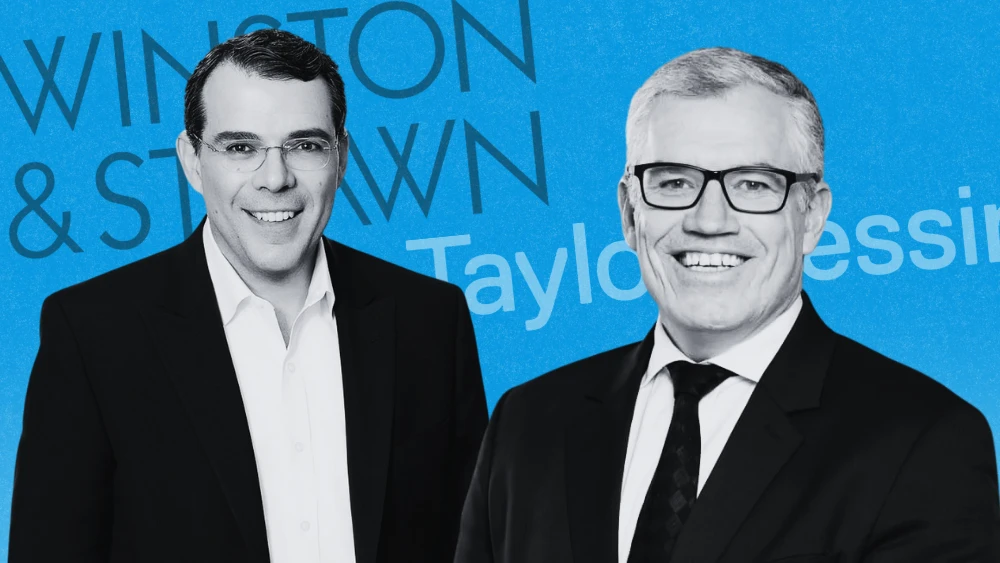
Winston & Strawn and Taylor Wessing’s UK-led businesses will merge to form a new firm, Winston Taylor, with completion expected in May 2026.
The deal accelerates Taylor Wessing’s US push and formalises its UK exit from the Swiss verein, while raising questions around integration and economics.
Following merger talks, Winston & Strawn and Taylor Wessing's UK-led businesses have agreed to combine in a full merger that will see the two firms come together under a new transatlantic law firm operating under the name Winston Taylor.
The deal at a glance
Once completed, the firm will have more than 1,400 lawyers spread across 20 offices, with its centre of gravity in the US and UK, alongside operations in Europe, Latin America and the Middle East. The major practices include litigation, transactions, strategic IP and private wealth, and the combined firm is estimated to land revenue somewhere around $1.75 billion.
The combination includes Taylor Wessing UK, Ireland, the Middle East, the Netherlands and Belgium. The remaining Taylor Wessing firms will continue to operate within the Taylor Wessing verein, but are expected to enter into cooperation and referral arrangements with Winston Taylor.
At the top, Winston & Strawn chairman Steve D’Amore will continue in his role, while Taylor Wessing UK managing partner Shane Gleghorn will serve as managing partner of Europe and the Middle East and join the new firm’s executive committee.
The deal is expected to complete in May 2026, subject to regulatory approvals and partner votes at both firms.
What’s in it for each side
Both firms describe the merger as a response to client demand for fully integrated US-UK-EU advice across litigation, transactions and IP. Winston & Strawn has spent several years trying to shake off its reputation as a litigation-led firm and build momentum in London, with the deal delivering a much deeper and more permanent UK foothold.
Chair Steve D’Amore said: "Once combined, we will have a London-headquartered partner that fulfils our long-held ambition to grow in the UK, while preserving the culture, agility, focus, and relentless client service that define Winston & Strawn."
Taylor Wessing, meanwhile, has centred its strategy on technology, life sciences and growth-company work, and the tie-up accelerates its push into the US after years of steady expansion across Europe and the Middle East.
The combined firm is pitching strength in strategic intellectual property, pairing Taylor Wessing’s UK-EU IP platform with Winston & Strawn’s US IP litigation practice to create what it says will be a market-leading transatlantic offering.
The fit question
Beyond IP, the strategic fit is less immediately clear.
The two firms bring different identities and growth trajectories, and there is ongoing debate about how closely their practices and strategies truly align. As you would expect, there is also background chatter about whether practices could be cut and if some partners will depart or be pushed out as part of the merger.
Some in the market have suggested that, on paper at least, Winston & Strawn and Taylor Wessing might each have appeared a more natural fit with different transatlantic partners - Winston & Strawn with Ashurst, and Taylor Wessing with Perkins Coie. In that parallel universe, the practice alignment looks clearer.
Still, private equity looks to be a strategic focus - and one that makes sense if Winston & Strawn continues to lean into tech and life sciences. Taylor Wessing brings a strong mid-market PE practice in those sectors, while Winston & Strawn has depth on the US side. If the firms can successfully combine those strengths, the logic of a tech-focused transatlantic PE platform becomes easier to see.
The hard part: economics
As with most UK-US mergers, economics sit at the centre of the integration challenge. Winston & Strawn last reported profit per equity partner of $3.5 million, compared with £1.1 million ($1.5 million) at Taylor Wessing UK, underlining a meaningful gap the firms will need to manage over time.
At associate level, attention has quickly turned to pay and work expectations. Newly qualified salaries currently sit at around £110,000 at Taylor Wessing UK, compared with roughly £160,000 at Winston & Strawn, alongside very different expectations on billable hours.
Taylor Wessing operates with a billable target of around 1,600 hours, a level that has long supported a strong work-life balance relative to US and Magic Circle firms. The prospect of integration with a US-anchored platform where associate bonus thresholds are typically closer to 2,000 hours has prompted questions about whether those expectations will shift over time.
Leaving the Swiss verein
The merger formalises Taylor Wessing UK’s departure from its long-standing verein structure. Upon completion, the UK business, alongside the Netherlands and Belgium practices, will leave the association and operate under the Winston Taylor brand, while the remaining Taylor Wessing firms continue within the verein.
The exit removes a structural constraint that had limited deeper financial and governance integration, particularly in the context of a US-anchored merger where fully integrated partnerships remain the norm.
Where this leaves them
The combination would create a transatlantic firm comfortably within the global top 35-40 by revenue and among the larger UK law firms.
Winston Taylor follows in the footsteps of a growing list of US-UK combinations over the past 18 months, including Herbert Smith Freehills and Kramer Levin, A&O Shearman, and Ashurst’s merger with Perkins Coie.
The creation of Winston Taylor answers long-standing questions about direction for both firms, but replaces them with harder ones about integration. The next phase will test whether shared ambition can overcome the practical realities of pay, culture and market positioning.
Join 10,000+ City law professionals who start their day with our newsletter.
The essential read for commercially aware lawyers.