Legora has unveiled the Legora aOS, a platform designed to orchestrate autonomous AI agents across end-to-end legal workflows.
The company said the system is built to integrate with firms’ existing tools and institutional knowledge, with lawyers remaining responsible for oversight and decision-making.
Legora is going all-in on AI agents with the launch of a new “operating system” designed to independently complete tasks with limited human input, rather than simply responding to prompts.
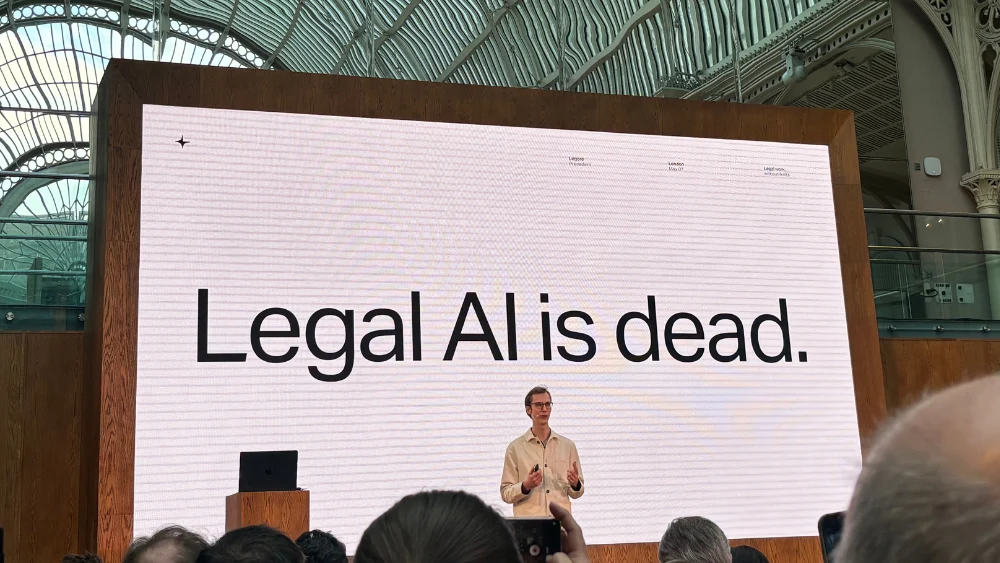
Onstage at the Legora conference in London yesterday, chief executive and co-founder Max Junestrand opened with the line: “Legal AI is dead”, before unveiling the Legora aOS.
Junestrand described a new era of “Agentic Law”, where legal work is executed autonomously and continuously with lawyers reviewing the end results.
The operating system is designed to function more like an associate carrying out work under supervision, with lawyers directing strategy and reviewing outputs while the system executes tasks in the background.
What legal agents do
At the centre of the platform is the Legora Agent, which the company described as the engine powering the wider system. Legora said the agent is capable of autonomously reviewing documents, conducting legal research, drafting responses and managing repetitive administrative work.
In one example outlined by the company, if a party sends through a contract redline at midnight, the agent can review every change, flag issues that need attention and draft a response, all by the time a lawyer sits down at their desk the next morning.
Junestrand said: "The ceiling of what's possible has always been limited by human capacity. The Legora aOS changes that. It is the operating system that enables legal teams to operate with machine intelligence at a scale, speed, and quality that simply wasn't possible before."
The operating system also connects directly with document management systems, legal research databases and email, while drawing on each firm’s internal knowledge, including playbooks, precedent libraries and client history.
Enter the legal engineer
Legora also used the conference to spotlight its fast-growing team of legal engineers - lawyers and legal technologists embedded within customer organisations to help with configuration, implementation and change management.
Junestrand said the company now has as many legal engineers as software engineers, positioning the role as central to helping firms adapt workflows and knowledge systems around the platform.
Regulatory intelligence
The launch also follows Legora’s acquisition this week of Graceview, a regulatory horizon-scanning platform.
Legora said the acquisition would add real-time regulatory intelligence capabilities to its wider platform, allowing firms to track and respond to regulatory developments within the same workflow environment.
Race for scale
The launch comes as legal technology providers increasingly compete to position AI systems as operational infrastructure for legal teams rather than standalone productivity tools.
Junestrand said firms adopting agentic systems early would help shape how legal services are delivered over the next decade.
“Agentic law is a fundamentally different model for how legal work gets done and what lawyers, legal teams, and law firms can achieve,” he said. “The firms that move first will define how law is practiced for the next decade.”
Legora’s technology is currently used by more than 1,000 law firms and in-house legal teams across 50 markets.
Join 10,000+ City law professionals who start their day with our newsletter.
The essential read for commercially aware lawyers.