Why A $500m Claim May Really Be Worth $76m
A more rigorous approach to valuing disputes can help claimants and defendants make smarter settlement decisions.



High-stakes commercial disputes involve significant risk and reward: potentially substantial damages, multiyear timelines, uncertain outcomes and reputational exposure.
But decisions about those disputes are often guided as much by instinct as by objective analysis. The result can be prolonged litigation, spiralling costs, organisational distraction and settlements that don’t reflect the underlying economic and strategic stakes.
A disciplined method of valuing claims offers a more rational path. By providing an objective reference point, valuation brings economic discipline and business sense to litigation strategy. It helps parties understand what a case is actually worth once risk, duration, costs and other factors are taken into account.
That can support better settlement decisions for both claimants and defendants, and improve communication between legal and commercial stakeholders to align expectations with reality.
Valuing litigation claims
Claimants and their legal advisers often begin by focusing on maximum damages - the largest conceivable recovery if every head of claim succeeds. But this headline figure is rarely the right benchmark for settlement. It can inflate expectations and distort negotiations, leading to unrealistic positions and protracted stand-offs.
A risk-adjusted framework provides a more realistic view of a claim's current value when approaching settlement talks. The process involves four core steps:
- Break the damages down into categories, such as lost profits, consequential damages and interest, and model a range of plausible outcomes - including the possibility of a zero recovery.
- Assign probabilities to each scenario based on factors including the strength of the evidence, legal precedent, forum, jurisdiction and anticipated fact-finding.
- Calculate the expected value, or weighted average damages outcome, across those scenarios.
- Adjust that expected value for risks affecting the case, including the possibility of losing outright, appeal or set-aside risk, enforcement risk, the defendant's creditworthiness and the cost of capital over the expected life of the dispute. Cost-shifting exposure may also need to be included in many jurisdictions, including in arbitrations.
Case study: Valuing a $500 million litigation
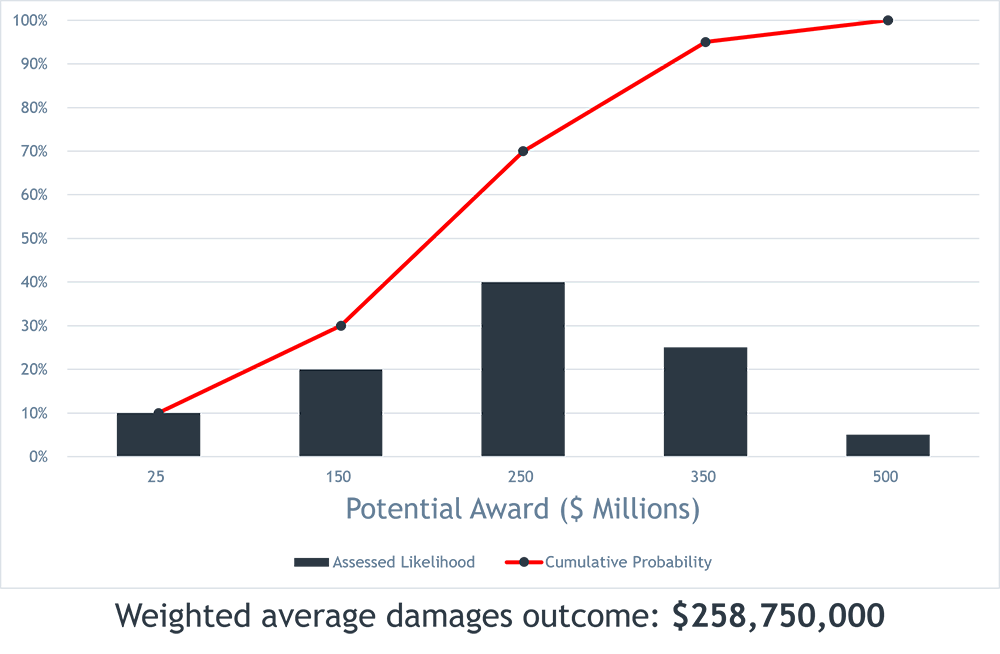
Client X has brought an English law claim with a theoretical maximum value of $500 million across four heads of claim, subject to a $25 million limitation of liability.
To assess the potential outcomes, lawyers and experts model the probability of each head of claim being awarded by the court or tribunal, with the cumulative probabilities adding up to 100%.
The resulting probability distribution makes it possible to calculate a weighted average damages outcome across the different scenarios.
The next stage applies the risks affecting the case at the time of valuation. These include a 35% chance of losing at trial, appellate and enforcement risk, a 10% cost of capital discount and approximately $10 million in legal fees. Together, those adjustments reduce the weighted average outcome of $258 million to a present value of $75.9 million.
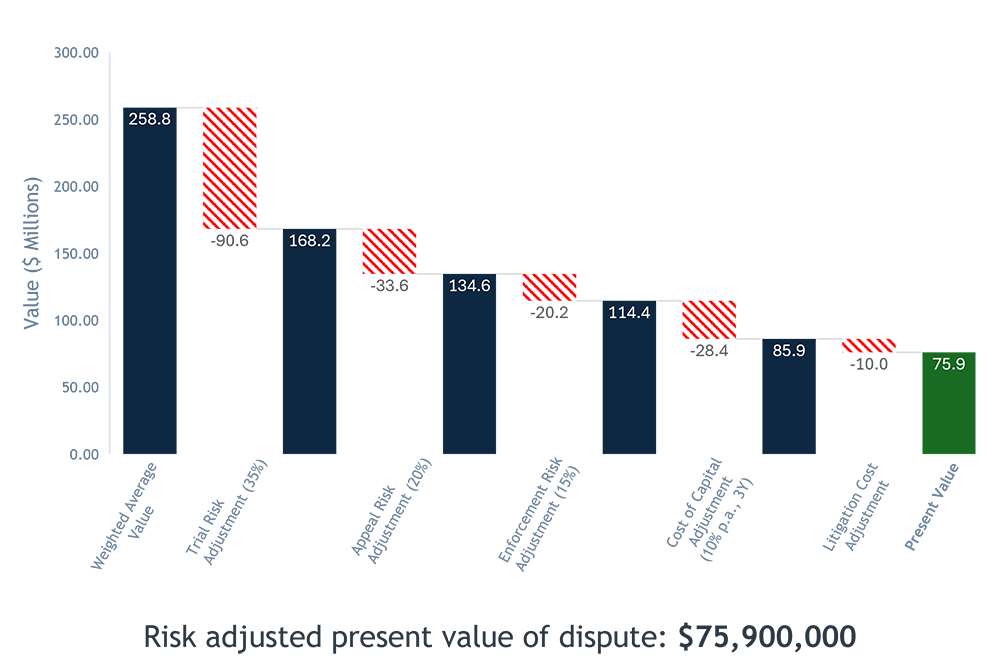
In practical terms, although the headline claim is $500 million, its risk-adjusted value is closer to $76 million.
At the outset of the dispute, a settlement at or above that figure could therefore represent a successful economic result for Client X once the risks of continuing the case are taken into account.
Valuing defendant-side disputes
The same valuation principles apply to defendants, but the focus shifts. For a defendant, the relevant comparison is not simply the potential damages. It is the risk-weighted cost of going to trial compared with the cost of settling today.
A defendant's model should therefore account for:
- The probability-weighted damages exposure
- Legal fees through trial and appeal
- Adverse costs, where applicable
- Reputational and commercial impact
- Enforcement uncertainty and timing
- The opportunity cost of capital tied up over the life of the dispute
In many cases, a substantial early settlement can be economically rational when the risks of continuing the defence outweigh the cost of payment. The defendant must compare the cost of settling now with the risk-adjusted cost of proceeding: could it ultimately be forced to pay even more?
Proper valuation gives defendants a framework for assessing those risks objectively and identifying a settlement figure that may leave them better off than resisting the claim to a judgment or award, or beyond.
Lawyers as translators
One of valuation's main benefits is that it translates legal risk into the commercial metrics used by C-suites, CFOs and boards to run the business. Lawyers play a critical role in that process, connecting legal analysis with financial modelling so decision-makers can compare litigation strategy with other risks and investments.
Valuation is not static. A well-designed model should be updated throughout a dispute as new evidence emerges, milestones are reached, liability assessments change and settlement dynamics shift. Used in this way, it becomes an ongoing guide to strategy rather than a one-off calculation.
Valuation models can also identify and quantify the issues separating claimants and defendants, helping each side establish a range of values for settlement negotiations. The parties will rarely agree on every probability, but a common framework can reduce information gaps and temper unrealistic positions - whether inflated damages demands or nominal settlement offers.
The factors a model cannot capture
Valuation brings useful discipline, but it cannot capture every dimension of a dispute. Settlement decisions also depend on qualitative and strategic considerations, including:
- Reputation and stakeholder impact: How will a settlement or judgment be viewed by investors, regulators or customers?
- Strategic signalling: Could settling encourage further claims? Could continuing the litigation deter future challenges?
- Liquidity and cash flow: Can the business afford multiyear uncertainty or a large upfront payment, regardless of the theoretical value?
- Timing and certainty: Does the business place a premium on finality, potentially justifying a settlement below - or above - the risk-adjusted value?
- Enforcement: How does the counterparty's ability to pay, or the difficulty of cross-border enforcement, affect a “fair” valuation?
These considerations must sit alongside the quantitative analysis. AI can help analyse objective inputs quickly and consistently, but assessing the qualitative dimensions still requires human judgment, experience and strategic insight. The question is not simply how
AI can inform valuation, but how it can be combined with expert advice to guide settlement and risk decisions.
Towards a smarter settlement culture
Litigation will always involve uncertainty, risk and emotion. Settlement decisions need not be driven by emotion alone. Data-led valuation provides an economically grounded way to understand what a dispute is genuinely worth and make more informed decisions as a result.
With a structured approach, claimants can avoid over-optimistic expectations, defendants can avoid costly gambles and lawyers can communicate more effectively with commercial stakeholders.
Combined with qualitative judgment, valuation can support a smarter settlement culture in which decisions are driven not by headline numbers, but by a clear view of risk and value.
Produced in partnership with Burford Capital, the institutional quality finance firm focused on law.