How AI Is Changing The Way Lawyers Learn
As AI takes on more legal work, firms are rethinking how junior lawyers develop the skills and judgement they need.



For junior lawyers, learning the job has long been closely tied to doing the work itself. Researching unfamiliar questions, producing first drafts and working through problems before receiving feedback from a more experienced lawyer have all formed part of the process.
AI is upending that model. As tools become capable of handling more research, drafting and analysis, law firms face a new training challenge: how to capture the benefits of the technology without removing the experiences through which lawyers learn.
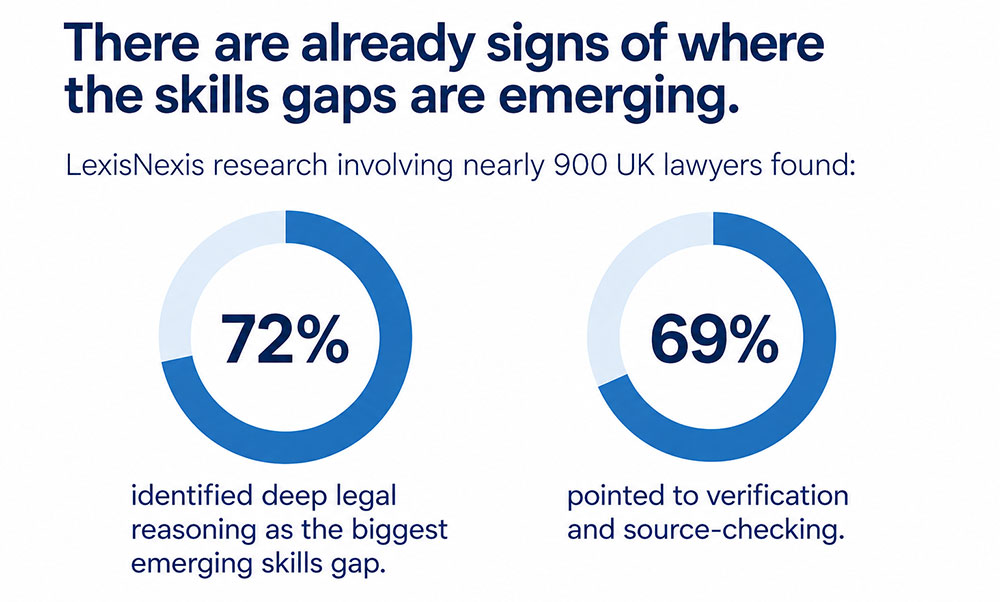
There are already signs of where the skills gaps are emerging. LexisNexis research involving nearly 900 UK lawyers found 72% identified deep legal reasoning as the biggest emerging skills gap, while 69% pointed to verification and source-checking.
Those skills are becoming more important as AI-related mistakes begin to surface across the profession, and the regulatory expectations are also hardening.
Following the High Court's Mazur ruling, the SRA updated its supervision guidance to address the use of AI, stressing the need for appropriate human review and scrutiny of AI-assisted work. It also recently warned firms over the misuse of AI after receiving 42 reports in the space of a year.
I think judgement comes from making decisions in the face of uncertainty and learning from that.
Christian Lang, head of innovation at legal education company BARBRI, has seen the changes from several angles. A former Davis Polk corporate lawyer, he later founded legal AI company Lega, which BARBRI acquired earlier this year. He believes one of the biggest questions is what happens to the development of legal judgement.
“I think judgement comes from making decisions in the face of uncertainty and learning from that,” he says.
AI, however, can shorten the time lawyers spend grappling with uncertainty. A junior faced with an unfamiliar problem can quickly generate an answer, a draft or a possible way forward, rather than having to reach an initial view themselves.
“One of the things we should be concerned about is that AI makes it harder to cultivate judgement in the same way, because you always have an answer handy, you always have a draft,” Lang says.
Learning differently
Lang ultimately expects the overall effect of AI on legal work to be positive, but believes firms will need to become more deliberate about how lawyers develop judgement as their work changes.
Rachel Broquard, Service Excellence Partner at Eversheds Sutherland, is confronting that question as part of the firm's work on AI adoption and training.
The firm is thinking about the skills needed by its lawyers across three broad areas: underlying legal knowledge, AI capabilities and softer skills such as communication and client engagement.
There is all sorts of potential and we are only restricted now by our creativity.
Traditional legal knowledge remains important because lawyers need to be able to assess what AI produces. Juniors may increasingly move from creating every piece of work themselves towards reviewing, verifying and improving AI-assisted work, putting greater emphasis on their ability to recognise when something is wrong.
But Broquard also sees AI as an opportunity to rethink some of the shortcomings of traditional legal training. Instead of waiting for the right matter or a partner with time to explain something, juniors can use it to ask questions in a more systematic way, test different scenarios and explore unfamiliar areas of law, giving them what she describes as a “university in a box”.
“There is all sorts of potential and we are only restricted now by our creativity,” she says.
AI fluency
For Lang, the shift also requires firms to distinguish between teaching lawyers to use AI and teaching them to work effectively in a profession being transformed by it.
He describes the latter as “AI fluency”.
Many firms are currently focused on adoption: rolling out tools, finding use cases and encouraging lawyers to incorporate them into existing workflows. Lang argues that is necessary, but insufficient.
“Instead of raising the floor, we really need to be focusing on raising the ceiling,” he says.
Instead of raising the floor, we really need to be focusing on raising the ceiling.
He compares AI development to learning a language. Lawyers can progress from basic awareness and literacy to practical skills, such as knowing how to perform particular tasks using particular tools. Fluency comes when that knowledge becomes transferable.
“You need to have a deep and transferable capability and understanding so you can interact with new and novel contexts and uncertain things and know what to do,” he says.
That includes understanding where AI can help, where it is likely to fail and where human judgement needs to take over. It also makes training tied exclusively to individual products less useful as a long-term solution in a market where the technology is changing rapidly.
Creating new reps
The challenge is ultimately to find new ways to give lawyers the “reps” that have traditionally come from years of practice.
Lang believes simulation will play a bigger role, and BARBRI is developing training around that idea. The aim is to put lawyers in situations where they have to make decisions, assess outputs and work through problems, recreating some of the “reps” that may become harder to accumulate as AI takes on more junior work.
The same emphasis on learning by doing extends to more senior lawyers, although the objective is different. BARBRI is building on experiential AI workshops developed by Lang and his team at Lega, which he describes as “high-end cooking classes for AI”.
In one session at a firm's partner retreat, partners built research agents to prepare them for business development meetings, giving them hands-on experience with AI through a task directly relevant to their work.
For partners, Lang argues, the goal is not to make them the most technically sophisticated AI users in the firm. It is to give them enough understanding of what the technology can do to combine it with the judgement and experience they already have.
“Working with more agentic systems, instructing them looks a lot more like instructing a junior lawyer than it does like working with a software programme,” he says.
That could make the relationship between experience and technology less straightforward than it first appears. Junior lawyers may arrive with greater familiarity with AI, while senior lawyers bring the judgement needed to use it effectively.
For firms, training will increasingly need to bring those capabilities together, rather than treating AI skills as something lawyers acquire separately from learning how to practise law.
Produced in partnership with BARBRI, a legal education provider trusted by leading law firms and organisations to train and develop the next generation of lawyers.