The office is back - and City law firms only want the best
As law firms compete for talent, clients and prestige, London’s office market has become high-stakes for scarce premium space.



Contents
London’s top law firms are spending more than ever on office space. Across the City, firms are signing leases years in advance, paying record rents and competing aggressively for a relatively small pool of premium buildings.
In a market once widely expected to weaken after the pandemic and the rise of hybrid working, demand at the top end has instead intensified, particularly for modern, amenity-rich headquarters close to major transport links.
CBRE, one of the world’s largest real estate firms, says demand for London's best offices is outstripping supply, with a relatively small number of new and newly refurbished buildings attracting intense competition. That imbalance is now driving sharp rental growth for the premium space in the City.
Jack Tomlin, executive director at CBRE, said that rents for top-tier buildings in prime City locations are at around £90 per square foot annually, but the highest rent achieved in the City Core, the heart of the Square Mile, recently reached as much as £150 per square foot.
US firm Proskauer signed additional space at 8 Bishopsgate tower for a reported record £147 per square foot, according to real estate analytics company CoStar.
The demand is concentrated largely in the heart of the Square Mile - particularly Moorgate, Liverpool Street, Bishopsgate and Broadgate, where the Elizabeth Line has transformed connectivity and accelerated demand.
The challenge for firms is that there are relatively few buildings that genuinely meet all of the requirements now expected from a top-tier headquarters: location, flexibility, wellness amenities, sustainability credentials, expansion potential and high-end client experience.
This helps explain why so many firms are starting their searches earlier, moving more aggressively and competing so intensely for the same shortlist of addresses.
Stay ahead of the City law market with our free email briefing - essential industry news and analysis, in your inbox three times a week.
The postcode game
Location has always mattered in the legal market, but the divide between London’s most sought-after postcodes has widened considerably over the last few years.
For many firms, the City Core has emerged as the dominant choice, combining transport connectivity, modern offices and proximity to clients. The Elizabeth Line has accelerated that shift, making areas around Liverpool Street and Moorgate even more attractive to firms competing for talent.
Tomlin says most UK and international firms are now “gravitating towards the City Core”, while large-scale developments around Bishopsgate and Broadgate are proving particularly popular because they can accommodate both open-plan working and more traditional private office configurations.
Recent moves underscore that trend. Linklaters relocated its London headquarters to 20 Ropemaker near Moorgate, while Clifford Chance is set to leave Canary Wharf for the City in 2028.
Not every firm is making the same calculation. Midtown, broadly the area between the West End and the City, remains attractive to firms with significant litigation practices that value proximity to the courts, such as Mishcon de Reya and Quinn Emanuel. Mishcon is reportedly in talks to expand its presence in Midtown, taking additional space at MidCity Place, around the corner from its primary office.
While a smaller group of firms, including Paul Weiss and McDermott have recently favoured the West End - a benefit being proximity to private equity and venture capital clients.
Beyond the desk
The modern law firm headquarters is increasingly designed less as a traditional workplace and more as a destination in its own right. In a market where firms compete fiercely for both talent and clients, office space has become another way to signal ambition and status.
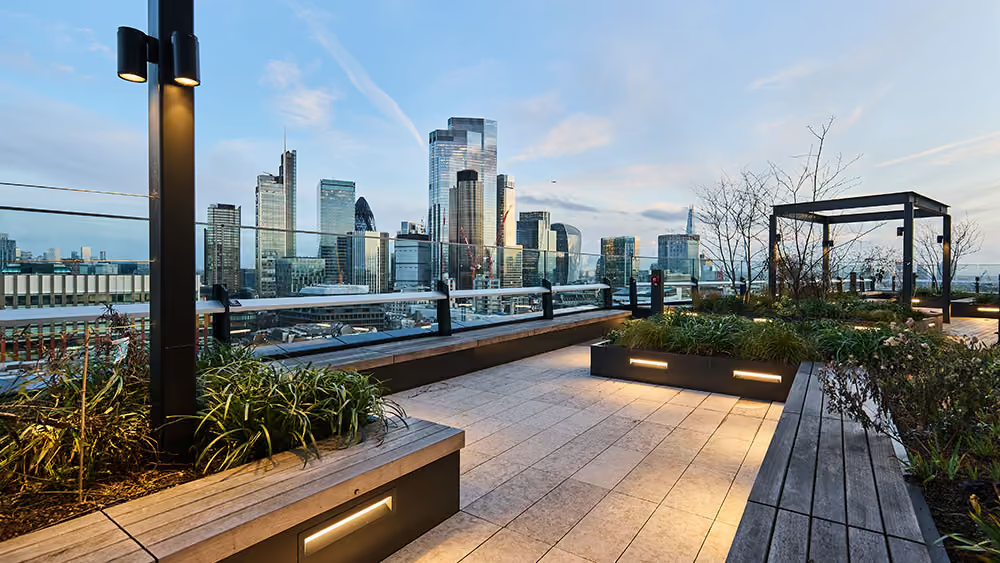
That shift is visible inside Addleshaw Goddard’s new London office at 41 Lothbury, where roof terraces, hospitality-style reception spaces and wellness amenities sit alongside legal workspaces. The firm relocated in 2025 after an extensive search process that began five years earlier led by Caroline Cleveley, the firm’s global head of property and workplace services.
Initially, the search followed a familiar pattern: the firm had a lease event approaching for its office at Milton Gate and needed to evaluate whether to stay or move. But as consultations with staff progressed, the conversation evolved into something broader about what lawyers actually wanted from the office.
“Natural light was key for us,” Cleveley says. “People were much more conscious of the things that they’d set up in their own home that really worked for them [during the pandemic] and wanted to replicate some of that in the workplace.”
We wanted to deliver something that is Instagrammable.
Cleveley describes the new office as a flagship “destination office” for the wider business. “We wanted to deliver something that’s Instagrammable,” she says. “People are really proud of it.”
Amenities previously considered secondary have become central to leasing decisions. Roof terraces, fitness studios, wellness rooms, cycle facilities and premium food offerings are now standard expectations in many top-end developments.
Last year, Paul Weiss completed a high-spec refurbishment of its Soho office, including its own sushi restaurant, which London co-head Neel Sachdev said was designed "to create an environment that encourages high in-office attendance”.
CBRE’s Tomlin says firms are increasingly focused on “magnetising” employees back into the office through higher-quality environments.
“Outdoor spaces such as roof terraces or courtyards are also in high demand for staff collaboration, client events and corporate entertainment,” he says.
Hotel lobby energy
Law firms are also becoming markedly more sophisticated about hospitality.
At Addleshaw Goddard, reception staff prepare in advance for every visitor entering the building, creating a highly personalised arrival experience inspired by luxury hotels. Guests are greeted by name, meetings are anticipated before guests arrive and front-of-house teams are encouraged to think about how they can “brighten people’s day”.
The approach reflects a wider shift in how firms think about offices as client environments as much as employee workplaces.
“The greeting is a real differentiator in the market,” Cleveley says. “We wanted to partner with a landlord that would enable us to do that and let us have a visible presence from the moment you walk in.”
.webp)
Richard Proctor, a partner at real estate agency Knight Frank, says firms increasingly want offices that project prestige while still allowing operational flexibility. Dedicated entrances and branded reception areas remain desirable, although fewer firms now insist on occupying entirely standalone headquarters.
We have seen a move away from a situation where most firms wanted their own building.
“We have seen a move away from a situation where most firms wanted their own building,” he says. “They realise if they go to a bigger building, there’s the ability to expand and flex as the business changes.
“People realise that having your own building creates a constraint. For example, if you grow, you might end up having to put people in an annex building down the street.”
For some firms, however, maintaining a distinctive arrival experience still carries significant weight. Proctor points to firms like Addleshaw Goddard and Slaughter and May as examples where front-of-house experience forms part of the broader brand identity.
But that doesn’t necessarily require occupying the entire building. Freshfields occupies 12 floors at 100 Bishopsgate and has its own desk in the reception and branding at the ground level. Earlier this year, HSF Kramer announced the firm would relocate its London headquarters to a modern building in the Broadgate with its own dedicated entrance.
Law Firm | Trainee First Year | Trainee Second Year | Newly Qualified (NQ) |
|---|---|---|---|
| Addleshaw Goddard | £52,000 | £56,000 | £100,000 |
| Akin | £60,000 | £65,000 | £174,418 |
| A&O Shearman | £56,000 | £61,000 | £150,000 |
| Ashurst Perkins Coie | £57,000 | £62,000 | £140,000 |
| Baker McKenzie | £56,000 | £61,000 | £150,000 |
| Bird & Bird | £48,500 | £53,500 | £102,000 |
| Bristows | £48,000 | £52,000 | £95,000 |
| Bryan Cave Leighton Paisner | £53,000 | £58,000 | £125,000 |
| Burges Salmon | £49,500 | £51,500 | £76,000 |
| Charles Russell Speechlys | £52,000 | £55,000 | £93,000 |
| Cleary Gottlieb | £62,500 | £67,500 | £172,500 |
| Clifford Chance | £56,000 | £61,000 | £150,000 |
| Clyde & Co | £48,500 | £51,000 | £90,000 |
| CMS | £50,000 | £55,000 | £120,000 |
| Cooley | £55,000 | £60,000 | £157,000 |
| Davis Polk | £65,000 | £70,000 | £180,000 |
| Debevoise | £55,000 | £60,000 | £173,000 |
| Dechert | £55,000 | £61,000 | £165,000 |
| Dentons | £52,000 | £56,000 | £104,000 |
| DLA Piper | £55,000 | £60,000 | £140,000 |
| Eversheds Sutherland | £50,000 | £55,000 | £120,000 |
| Farrer & Co | £48,500 | £51,000 | £89,000 |
| Fieldfisher | £48,500 | £52,000 | £100,000 |
| Freshfields | £56,000 | £61,000 | £150,000 |
| Fried Frank | £55,000 | £60,000 | £175,000 |
| Gibson Dunn | £65,000 | £70,000 | £180,000 |
| Goodwin Procter | £55,000 | £60,000 | £175,000 |
| Gowling WLG | £48,500 | £53,500 | £108,000 |
| Herbert Smith Freehills Kramer | £56,000 | £61,000 | £145,000 |
| HFW | £52,000 | £56,000 | £103,500 |
| Hill Dickinson | £44,000 | £45,000 | £80,000 |
| Hogan Lovells | £56,000 | £61,000 | £145,000 |
| Irwin Mitchell | £43,500 | £45,500 | £78,000 |
| Jones Day | £60,000 | £68,000 | £170,000 |
| K&L Gates | £50,000 | £55,000 | £115,000 |
| Kennedys | £43,000 | £46,000 | £85,000 |
| King & Spalding | £62,000 | £67,000 | £175,000 |
| Kirkland & Ellis | £60,000 | £65,000 | £174,418 |
| Latham & Watkins | £60,000 | £65,000 | £174,418 |
| Linklaters | £56,000 | £61,000 | £150,000 |
| Macfarlanes | £60,000 | £65,000 | £150,000 |
| Mayer Brown | £55,000 | £60,000 | £150,000 |
| McDermott Will & Schulte | £65,000 | £70,000 | £174,418 |
| Milbank | £65,000 | £70,000 | £174,418 |
| Mills & Reeve | £46,800 | £47,000 | £84,000 |
| Mishcon de Reya | £52,500 | £57,500 | £110,000 |
| Morgan Lewis | £57,500 | £62,500 | £173,000 |
| Norton Rose Fulbright | £56,000 | £61,000 | £140,000 |
| Orrick | £60,000 | £65,000 | £170,000 |
| Osborne Clarke | £55,500 | £57,500 | £97,000 |
| Paul Hastings | £60,000 | £68,000 | £173,000 |
| Paul Weiss | £60,000 | £65,000 | £180,000 |
| Penningtons Manches Cooper | £48,000 | £50,000 | £83,000 |
| Pinsent Masons | £54,000 | £59,000 | £109,000 |
| Quinn Emanuel | n/a | n/a | £189,000 |
| Reed Smith | £55,000 | £60,000 | £135,000 |
| Ropes & Gray | £62,000 | £67,000 | £170,000 |
| RPC | £48,000 | £52,000 | £95,000 |
| Shoosmiths | £45,000 | £47,000 | £105,000 |
| Sidley Austin | £60,000 | £65,000 | £175,000 |
| Simmons & Simmons | £56,000 | £61,000 | £130,000 |
| Simpson Thacher | n/a | n/a | £178,000 |
| Skadden | £58,000 | £63,000 | £177,000 |
| Slaughter and May | £56,000 | £61,000 | £150,000 |
| Squire Patton Boggs | £50,000 | £55,000 | £110,000 |
| Stephenson Harwood | £50,000 | £55,000 | £105,000 |
| Sullivan & Cromwell | £65,000 | £70,000 | £177,000 |
| TLT | £44,000 | £47,500 | £85,000 |
| Travers Smith | £55,000 | £60,000 | £130,000 |
| Trowers & Hamlins | £50,000 | £54,000 | £90,000 |
| Vinson & Elkins | £60,000 | £65,000 | £173,077 |
| Watson Farley & Williams | £51,500 | £56,000 | £107,000 |
| Weightmans | £36,000 | £38,000 | £70,000 |
| Weil | £60,000 | £65,000 | £170,000 |
| White & Case | £62,000 | £67,000 | £175,000 |
| Willkie Farr & Gallagher | £60,000 | £65,000 | £180,000 |
| Winston Taylor | £56,000 | £61,000 | £125,000 |
| Withers | £47,000 | £52,000 | £95,000 |
| Womble Bond Dickinson | £43,000 | £45,000 | £83,000 |
Rank | Law Firm | Revenue | Profit per Equity Partner (PEP) |
|---|---|---|---|
| 1 | DLA Piper* | £3,130,000,000 | £2,500,000 |
| 2 | A&O Shearman | £2,900,000,000 | £2,000,000 |
| 3 | Clifford Chance | £2,400,000,000 | £2,100,000 |
| 4 | Hogan Lovells | £2,320,000,000 | £2,400,000 |
| 5 | Linklaters | £2,320,000,000 | £2,200,000 |
| 6 | Freshfields | £2,250,000,000 | Not disclosed |
| 7 | CMS** | £1,800,000,000 | Not disclosed |
| 8 | Norton Rose Fulbright* | £1,800,000,000 | Not disclosed |
| 9 | HSF Kramer | £1,360,000,000 | £1,400,000 |
| 10 | Ashurst | £1,030,000,000 | £1,390,000 |
| 11 | Clyde & Co | £854,000,000 | Not disclosed |
| 12 | Eversheds Sutherland | £769,000,000 | £1,400,000 |
| 13 | Pinsent Masons | £680,000,000 | £790,000 |
| 14 | Slaughter and May*** | £650,000,000 | Not disclosed |
| 15 | BCLP* | £640,000,000 | £790,000 |
| 16 | Simmons & Simmons | £615,000,000 | £1,120,000 |
| 17 | Bird & Bird** | £580,000,000 | £720,000 |
| 18 | Addleshaw Goddard | £550,000,000 | £1,000,000 |
| 19 | Taylor Wessing | £526,000,000 | £1,100,000 |
| 20 | Osborne Clarke** | £476,000,000 | £800,000 |
| 21 | DWF | £466,000,000 | Not disclosed |
| 22 | Womble Bond Dickinson | £450,000,000 | Not disclosed |
| 23 | Kennedys | £428,000,000 | Not disclosed |
| 24 | Fieldfisher | £385,000,000 | £1,000,000 |
| 25 | Macfarlanes | £371,000,000 | £3,100,000 |
What do City lawyers actually do each day?
For a closer look at the day-to-day of some of the most common types of lawyers working in corporate law firms, explore our lawyer job profiles:
Paying more for less
One of the most counterintuitive trends shaping London’s legal market is that many firms are occupying less space while simultaneously spending more on their offices.
Hybrid working has reduced the need for permanently assigned desks giving way to hot-desking and allowing firms to shrink parts of their footprint. Yet overall costs continue to rise because firms are prioritising quality over quantity.
“The cost of your talent is way higher than your real estate costs,” says Proctor. “If you’re in a lower-quality building that means higher staff attrition rates and lower productivity, then it becomes less of a cost to move and pay the higher rent.”
That calculation helps explain why demand has remained resilient even as rents climb.
Law firms are also grappling with a shortage of suitable space, particularly for larger headquarters requirements.
According to CBRE and Knight Frank, major occupiers seeking at least 100,000 square feet often begin searching four to five years before lease expiry to secure the right building, while small to medium-sized firms typically start looking two to three years in advance.
Once we ruled out buildings that weren’t in the right location, the right size or available in the right time frame, we were down to a handful of options.
That pressure is reshaping the wider office landscape. Older secondary stock is becoming harder to lease, while newly refurbished or newly developed buildings continue attracting strong demand despite premium pricing.
The result is an increasing divide between top-tier offices and older stock that many law firms increasingly viewed as less desirable.
“Even second-hand buildings in core locations are likely to see some rental growth in the context of the lack of options,” said Tomlin.
Cleveley said: “We went out to market with a size in mind and being within that square mile of the City of London was a key priority. We wanted a brand new ‘plug and play’ building that didn’t require refurbishment.
“Very quickly, the shortlist became small. Once we ruled out buildings that weren’t in the right location, the right size or available in the right time frame, we were down to a handful of options.”
The stay-or-go dilemma
For some law firms, remaining in an existing building makes financial sense, but the challenges are especially apparent for firms occupying older offices, once considered high quality 15 or 20 years ago, that now struggle to meet modern expectations around amenities, ventilation, sustainability and natural light.
Landlords and occupiers alike are increasingly confronting the reality that many buildings no longer meet modern expectations. Firms are scrutinising everything from air conditioning systems to lifts.
Proctor said: “There’s a real drop-off when you get to 15 or 20-year-old buildings. You can do a lot with design, but there are limitations.
“You can try and do miracles with fit out,” he says, “but if the building is not fit for purpose, you’re not going to close that gap.”
You can do a lot with design, but there are limitations.
Tomlin said: “Law firms choosing to renew existing leases, where possible, often results in a more attractive economic proposition in terms of both lower rents, but also the ability to mitigate the high capital expenditure associated with new office fit out.”
Not every firm chooses to relocate, however, and the stay-put strategy has its advantages.
Taylor Wessing, now Winston Taylor following its merger with Winston & Strawn, is one firm that has opted to stay put. Rather than relocate permanently, the firm undertook an extensive 18-month refurbishment of its Midtown headquarters, a project that required temporary relocation arrangements while the works were completed.
The "stay versus go” decision is rarely straightforward. Refurbishments can be lengthy, complex and expensive in their own right, but they also allow firms to modernise existing space while retaining a familiar location and avoiding the hefty costs of fitting out a new headquarters.
There is often a sustainability component as well. Taylor Wessing said the refurbishment project resulted in a 56% reduction in carbon emissions compared with a new-build alternative. Managing partner Shane Gleghorn said remaining in the building reflected both "environmental responsibility” and “a strategic advantage”.
| Firm | London office since | Known for in London |
|---|---|---|
| Akin | 1997 | Restructuring, funds |
| Baker McKenzie | 1961 | Finance, capital markets, TMT |
| Davis Polk | 1972 | Leveraged finance, corporate/M&A |
| Gibson Dunn | 1979 | Private equity, arbitration, energy, resources and infrastructure |
| Goodwin | 2008 | Private equity, funds, life sciences |
| Kirkland & Ellis | 1994 | Private equity, funds, restructuring |
| Latham & Watkins | 1990 | Finance, private equity, capital markets |
| McDermott Will & Schulte | 1998 | Finance, funds, healthcare |
| Milbank | 1979 | Finance, capital markets, energy, resources and infrastructure |
| Paul Hastings | 1997 | Leveraged finance, structured finance, infrastructure |
| Paul Weiss | 2001 | Private equity, leveraged finance |
| Quinn Emanuel | 2008 | Litigation |
| Sidley Austin | 1974 | Leveraged finance, capital markets, corporate/M&A |
| Simpson Thacher | 1978 | Leveraged finance, private equity, funds |
| Skadden | 1988 | Finance, corporate/M&A, arbitration |
| Sullivan & Cromwell | 1972 | Corporate/M&A, restructuring, capital markets |
| Weil | 1996 | Restructuring, private equity, leverage finance |
| White & Case | 1971 | Capital markets, arbitration, energy, resources and infrastructure |
| Law firm | Type | First-year salary |
|---|---|---|
| White & Case | US firm | £32,000 |
| Stephenson Harwood | International | £30,000 |
| A&O Shearman | Magic Circle | £28,000 |
| Charles Russell Speechlys | International | £28,000 |
| Freshfields | Magic Circle | £28,000 |
| Herbert Smith Freehills | Silver Circle | £28,000 |
| Hogan Lovells | International | £28,000 |
| Linklaters | Magic Circle | £28,000 |
| Mishcon de Reya | International | £28,000 |
| Norton Rose Fulbright | International | £28,000 |
Law Firm | Trainee First Year | Trainee Second Year | Newly Qualified (NQ) |
|---|---|---|---|
| A&O Shearman | £56,000 | £61,000 | £150,000 |
| Clifford Chance | £56,000 | £61,000 | £150,000 |
| Freshfields Bruckhaus Deringer | £56,000 | £61,000 | £150,000 |
| Linklaters | £56,000 | £61,000 | £150,000 |
| Slaughter and May | £56,000 | £61,000 | £150,000 |
Law Firm | Trainee First Year | Trainee Second Year | Newly Qualified (NQ) |
|---|---|---|---|
| A&O Shearman | £56,000 | £61,000 | £150,000 |
| Clifford Chance | £56,000 | £61,000 | £150,000 |
| Freshfields Bruckhaus Deringer | £56,000 | £61,000 | £150,000 |
| Linklaters | £56,000 | £61,000 | £150,000 |
| Slaughter and May | £56,000 | £61,000 | £150,000 |
Law Firm | Trainee First Year | Trainee Second Year | Newly Qualified (NQ) |
|---|---|---|---|
| Ashurst | £57,000 | £62,000 | £140,000 |
| Bryan Cave Leighton Paisner | £53,000 | £58,000 | £125,000 |
| Herbert Smith Freehills | £56,000 | £61,000 | £145,000 |
| Macfarlanes | £60,000 | £65,000 | £150,000 |
| Travers Smith | £55,000 | £60,000 | £130,000 |
| Firm | Merger year | Known for in London |
|---|---|---|
| BCLP | 2018 | Real estate, corporate/M&A, litigation |
| DLA Piper | 2005 | Corporate/M&A, real estate, energy, resources and infrastructure |
| Eversheds Sutherland | 2017 | Corporate/M&A, finance |
| Hogan Lovells | 2011 | Litigation, regulation, finance |
| Mayer Brown | 2002 | Finance, capital markets, real estate |
| Norton Rose Fulbright | 2013 | Energy, resources and infrastructure, insurance, finance |
| Reed Smith | 2007 | Shipping, finance, TMT |
| Squire Patton Boggs | 2011 | Corporate/M&A, pensions, TMT |
Law Firm | Trainee First Year | Trainee Second Year | Newly Qualified (NQ) |
|---|---|---|---|
| Ashurst | £57,000 | £62,000 | £140,000 |
| Bryan Cave Leighton Paisner | £53,000 | £58,000 | £125,000 |
| Herbert Smith Freehills Kramer | £56,000 | £61,000 | £145,000 |
| Macfarlanes | £60,000 | £65,000 | £150,000 |
| Travers Smith | £55,000 | £60,000 | £130,000 |
Know what's moving the market
Get the free email that keeps UK lawyers ahead on the stories that matter.
We send a short summary of the biggest legal industry and business stories you need to know about three times a week. Free to join. Unsubscribe at any time.