Meet the vet turned Sidley partner advising on high-stakes life sciences mandates
Chris Boyle’s move from veterinary practice to law shows how a scientific background can shape a Big Law career.


Contents
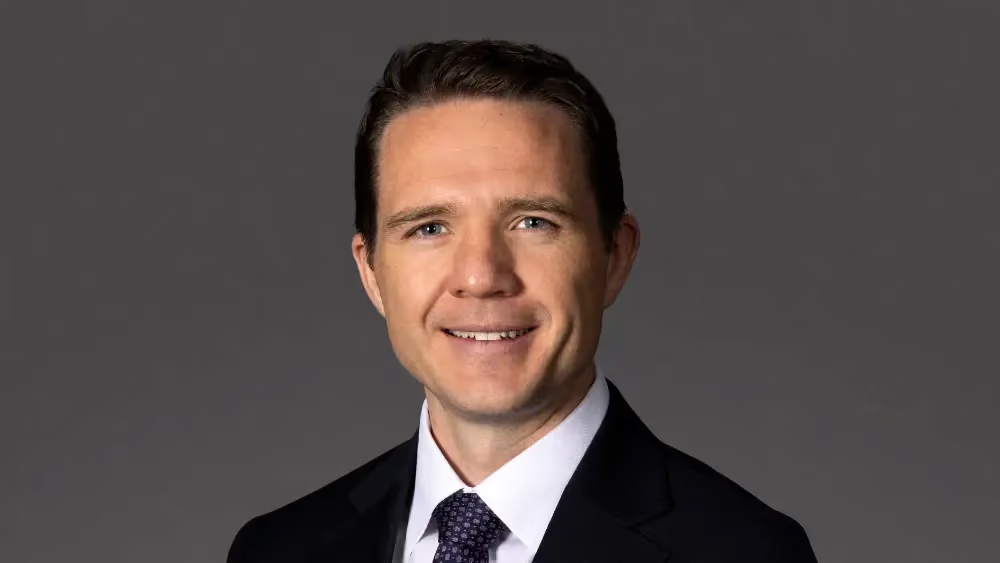
Chris Boyle’s career path is not what you might expect from a City lawyer. Trained as a veterinary surgeon, he began his professional life in clinical practice before pivoting into law and building a career advising some of the world’s most innovative life sciences companies at one of the world’s top law firms.
Now a partner at Sidley Austin in London, his work spans human and animal health, regulatory strategy, litigation and private equity-backed deals in a sector undergoing rapid scientific and commercial change.
When I sat down with him, he reflected on why he left veterinary practice, how a scientific background continues to shape his legal work, and what lies ahead for life sciences, animal health and pets that are increasingly treated as part of the family.
Early passions
“I've always been passionate about science and I knew I wanted a career focused on science in some way, but I didn't know ultimately what that would look like,” he says.
In school, he followed his interest in science at A level, ultimately landing on a veterinary degree that combined his passions for science and animals.
Life as a vet
Before committing to vet school, Boyle had some exposure to the profession.
“Before starting vet school, I had a lot of hands-on experience in practice, on farms, at zoos, so I had a good idea of what the career looked like. Though, I hadn't experienced some of the day-to-day challenges of being a vet.”
One of those challenges, he says, is the tension between ideal care and commercial reality.
There's no NHS for animals.
“A challenge of the job as a vet is that you're not always in a position to give the gold standard care that's available because clients may not be able to afford it and tough decisions have to be made. There's no NHS for animals.”
The pivot to law
Boyle began to question whether veterinary medicine was the best way to use his scientific training.
“I loved clinical practice and the colleagues and clients I met as part of that veterinary journey, but I felt that I wanted to use my scientific knowledge in a different way. So, I continued to explore other ways in which I could use my degree.”
Law offered a way to stay close to science beyond the clinic.
A scientific edge
Today, Boyle’s combined veterinary and legal training underpins his work advising life sciences businesses, including pharmaceutical companies, medtechs and biotechs.
“My veterinary degree combined with a law qualification allows me to assist companies to bring cutting edge drugs and medical devices to market, and to have a meaningful impact on healthcare, even on a global scale.”
Being able to speak the same language…is an asset, and it makes the job really enjoyable.
“Being able to speak the same language as the businesses that we represent and to get excited about their scientific advances, the new drugs and devices that they're developing, is an asset, and it makes the job really enjoyable.”
Transferable skills
Boyle sees some parallels between veterinary practice and legal work.
“Both professions are centred around providing a great service for your clients. And my experience helping clients in veterinary medicine, working collaboratively with a team and working in high stress situations is very transferable to law.”
Stay ahead of the City law market with our free email briefing - essential industry news and analysis, in your inbox three times a week.
Inside his law practice
Boyle’s practice spans regulatory advice and contentious work.
“I have a broad practice that's centred on providing regulatory advice to help guide companies through the process of obtaining approvals for their drugs and their devices, but I'm also a solicitor advocate and I litigate on behalf of companies,” he says.
That can include challenging regulators directly.
“Perhaps the company's been unable to obtain a regulatory approval or has difficulty maintaining it, we can support them to navigate those regulatory challenges, and if necessary, contest a decision of a regulator.”
His work has even taken him all the way to the Supreme Court on two occasions, on behalf of clients.
Those experiences, he says, are particularly satisfying, not only for the client, but also because they provide greater certainty for the industry, shaping how similar disputes are approached in the future.
He also works closely with private equity and M&A colleagues on life sciences transactions.
“We do the day-to-day regulatory advice and litigation work for life sciences companies, so we're able to identify risks and opportunities as part of that diligence process for deals,” he says.
Human and animal health intersect
Boyle’s work covers both human and animal medicines and devices, which share some scientific foundations but operate under different legal frameworks.
While the legal aspects differ, the developments in human health have potential for application in animals as well. “I've certainly seen technologies transfer from humans to animals and vice versa,” he says.
“I do a lot of work with animal health companies developing innovative new treatments and technologies. And what can give those companies a headstart is the availability of pre-clinical data from the regulatory approval process for human drugs, which can support development in animals or provide proof of concept.”
Healthcare for pets
Changing attitudes to pets are also reshaping the market as pets start to receive treatments that look more like human healthcare.
Animals are increasingly becoming part of the family.
“Animals are increasingly becoming part of the family and owners value their pet's health, and their time with their pets, more than ever. We're seeing novel therapies such as monoclonal antibody treatments, gene editing, and there's potential for gene therapies.”
A growing investor focus
That innovation has not gone unnoticed by investors. The animal health sector has been very attractive to private equity and venture capital in recent years, having been seen as a recession resistant sector - and an area that fits naturally into Sidley’s private equity-led London push.
“We've seen a lot of activity in veterinary services, clinical research organisations, and consultancies - there are a lot of the stable, high-value services in the veterinary world. We are also seeing take-privates and private equity sponsored buyouts in the animal health sector.”
Human health has also seen renewed momentum.
“We’ve seen a big uptick in activity last year, with particular interest in AI leveraged devices. Diagnostics and newer technologies are leveraging the abundant health data that is becoming available.”
Law Firm | Trainee First Year | Trainee Second Year | Newly Qualified (NQ) |
|---|---|---|---|
| Addleshaw Goddard | £52,000 | £56,000 | £100,000 |
| Akin | £60,000 | £65,000 | £174,418 |
| A&O Shearman | £56,000 | £61,000 | £150,000 |
| Ashurst Perkins Coie | £57,000 | £62,000 | £140,000 |
| Baker McKenzie | £56,000 | £61,000 | £150,000 |
| Bird & Bird | £48,500 | £53,500 | £102,000 |
| Bristows | £48,000 | £52,000 | £95,000 |
| Bryan Cave Leighton Paisner | £53,000 | £58,000 | £125,000 |
| Burges Salmon | £49,500 | £51,500 | £76,000 |
| Charles Russell Speechlys | £52,000 | £55,000 | £93,000 |
| Cleary Gottlieb | £62,500 | £67,500 | £164,500 |
| Clifford Chance | £56,000 | £61,000 | £150,000 |
| Clyde & Co | £48,500 | £51,000 | £90,000 |
| CMS | £50,000 | £55,000 | £120,000 |
| Cooley | £55,000 | £60,000 | £157,000 |
| Davis Polk | £65,000 | £70,000 | £180,000 |
| Debevoise | £55,000 | £60,000 | £173,000 |
| Dechert | £55,000 | £61,000 | £165,000 |
| Dentons | £52,000 | £56,000 | £104,000 |
| DLA Piper | £55,000 | £60,000 | £140,000 |
| Eversheds Sutherland | £50,000 | £55,000 | £120,000 |
| Farrer & Co | £48,500 | £51,000 | £89,000 |
| Fieldfisher | £48,500 | £52,000 | £100,000 |
| Freshfields | £56,000 | £61,000 | £150,000 |
| Fried Frank | £55,000 | £60,000 | £175,000 |
| Gibson Dunn | £65,000 | £70,000 | £180,000 |
| Goodwin Procter | £55,000 | £60,000 | £175,000 |
| Gowling WLG | £48,500 | £53,500 | £108,000 |
| Herbert Smith Freehills Kramer | £56,000 | £61,000 | £145,000 |
| HFW | £52,000 | £56,000 | £103,500 |
| Hill Dickinson | £44,000 | £45,000 | £80,000 |
| Hogan Lovells | £56,000 | £61,000 | £145,000 |
| Irwin Mitchell | £43,500 | £45,500 | £78,000 |
| Jones Day | £60,000 | £68,000 | £170,000 |
| K&L Gates | £50,000 | £55,000 | £115,000 |
| Kennedys | £43,000 | £46,000 | £85,000 |
| King & Spalding | £62,000 | £67,000 | £175,000 |
| Kirkland & Ellis | £60,000 | £65,000 | £174,418 |
| Latham & Watkins | £60,000 | £65,000 | £174,418 |
| Linklaters | £56,000 | £61,000 | £150,000 |
| Macfarlanes | £60,000 | £65,000 | £150,000 |
| Mayer Brown | £55,000 | £60,000 | £150,000 |
| McDermott Will & Schulte | £65,000 | £70,000 | £174,418 |
| Milbank | £65,000 | £70,000 | £174,418 |
| Mills & Reeve | £46,800 | £47,000 | £84,000 |
| Mishcon de Reya | £52,500 | £57,500 | £110,000 |
| Morgan Lewis | £57,500 | £62,500 | £173,000 |
| Norton Rose Fulbright | £56,000 | £61,000 | £140,000 |
| Orrick | £60,000 | £65,000 | £170,000 |
| Osborne Clarke | £55,500 | £57,500 | £97,000 |
| Paul Hastings | £60,000 | £68,000 | £173,000 |
| Paul Weiss | £60,000 | £65,000 | £180,000 |
| Penningtons Manches Cooper | £48,000 | £50,000 | £83,000 |
| Pinsent Masons | £54,000 | £59,000 | £109,000 |
| Quinn Emanuel | n/a | n/a | £189,000 |
| Reed Smith | £55,000 | £60,000 | £135,000 |
| Ropes & Gray | £62,000 | £67,000 | £170,000 |
| RPC | £48,000 | £52,000 | £95,000 |
| Shoosmiths | £45,000 | £47,000 | £105,000 |
| Sidley Austin | £60,000 | £65,000 | £175,000 |
| Simmons & Simmons | £56,000 | £61,000 | £130,000 |
| Simpson Thacher | n/a | n/a | £178,000 |
| Skadden | £58,000 | £63,000 | £177,000 |
| Slaughter and May | £56,000 | £61,000 | £150,000 |
| Squire Patton Boggs | £50,000 | £55,000 | £110,000 |
| Stephenson Harwood | £50,000 | £55,000 | £105,000 |
| Sullivan & Cromwell | £65,000 | £70,000 | £177,000 |
| TLT | £44,000 | £47,500 | £85,000 |
| Travers Smith | £55,000 | £60,000 | £130,000 |
| Trowers & Hamlins | £50,000 | £54,000 | £90,000 |
| Vinson & Elkins | £60,000 | £65,000 | £173,077 |
| Watson Farley & Williams | £51,500 | £56,000 | £107,000 |
| Weightmans | £36,000 | £38,000 | £70,000 |
| Weil | £60,000 | £65,000 | £170,000 |
| White & Case | £62,000 | £67,000 | £175,000 |
| Willkie Farr & Gallagher | £60,000 | £65,000 | £180,000 |
| Winston Taylor | £56,000 | £61,000 | £125,000 |
| Withers | £47,000 | £52,000 | £95,000 |
| Womble Bond Dickinson | £43,000 | £45,000 | £83,000 |
Rank | Law Firm | Revenue | Profit per Equity Partner (PEP) |
|---|---|---|---|
| 1 | DLA Piper* | £3,130,000,000 | £2,500,000 |
| 2 | A&O Shearman | £2,900,000,000 | £2,000,000 |
| 3 | Clifford Chance | £2,400,000,000 | £2,100,000 |
| 4 | Hogan Lovells | £2,320,000,000 | £2,400,000 |
| 5 | Linklaters | £2,320,000,000 | £2,200,000 |
| 6 | Freshfields | £2,250,000,000 | Not disclosed |
| 7 | CMS** | £1,800,000,000 | Not disclosed |
| 8 | Norton Rose Fulbright* | £1,800,000,000 | Not disclosed |
| 9 | HSF Kramer | £1,360,000,000 | £1,400,000 |
| 10 | Ashurst | £1,030,000,000 | £1,390,000 |
| 11 | Clyde & Co | £854,000,000 | Not disclosed |
| 12 | Eversheds Sutherland | £769,000,000 | £1,400,000 |
| 13 | Pinsent Masons | £680,000,000 | £790,000 |
| 14 | Slaughter and May*** | £650,000,000 | Not disclosed |
| 15 | BCLP* | £640,000,000 | £790,000 |
| 16 | Simmons & Simmons | £615,000,000 | £1,120,000 |
| 17 | Bird & Bird** | £580,000,000 | £720,000 |
| 18 | Addleshaw Goddard | £550,000,000 | £1,000,000 |
| 19 | Taylor Wessing | £526,000,000 | £1,100,000 |
| 20 | Osborne Clarke** | £476,000,000 | £800,000 |
| 21 | DWF | £466,000,000 | Not disclosed |
| 22 | Womble Bond Dickinson | £450,000,000 | Not disclosed |
| 23 | Kennedys | £428,000,000 | Not disclosed |
| 24 | Fieldfisher | £385,000,000 | £1,000,000 |
| 25 | Macfarlanes | £371,000,000 | £3,100,000 |
What do City lawyers actually do each day?
For a closer look at the day-to-day of some of the most common types of lawyers working in corporate law firms, explore our lawyer job profiles:
Regulation as opportunity
Rather than deterring investment, Boyle argues regulation can be a competitive advantage.
“In highly regulated industries, those regulations can be perceived as a barrier to market entry, but also an opportunity for the companies that can navigate those regulations whether that is food safety, drugs and personalised medicines, wearables or new diagnostic devices.”
Regulations can be perceived as a barrier to market entry, but also an opportunity.
Companies that embrace those risks and can secure regulatory approvals while demonstrating quality, safety and efficacy are rewarded, he says.
Global scope
Much of Boyle’s work is international, reflecting the global footprint of many life sciences companies.
“I'm on the phone to colleagues or clients in the US or in Europe nearly every day,” he says.
In the UK and the EU, the cross-border dimension has become more complicated since Brexit creating added complexity for product launches in multiple markets.
“There’s a call from industry for harmonisation to minimise the burden of having to comply with two sets of laws, different rules and labelling, and different approval requirements,” he says.
At the same time, Boyle sees some advantages of the setup. Greater regulatory flexibility has given the UK medicines regulator more scope to take innovative approaches, including streamlining approval processes and, in some cases, relying on approvals granted by other regulators, accelerating patient access to medicines.
Navigating what’s next
The regulatory environment for life sciences is changing quickly, shaped by geopolitical pressures, shifting approaches to drug pricing and a wave of legislative reform. In Europe, that includes the biggest overhaul of pharmaceutical legislation in decades.
As Boyle puts it, “there's an enormous amount for our clients to juggle at a time where they need to achieve growth, but also need to navigate new regulations, new risks on multiple fronts, but also new opportunities.”
No regrets
Looking back, Boyle has no regrets about the route he took.
I definitely feel I made the right decision, but I also say that I would still take the same route to law.
“I definitely feel I made the right decision, but I also say that I would still take the same route to law. I would still do my veterinary degree, which I really value to this day. I think that helped me find an area of law which I'm particularly passionate about,” he says.
“I would encourage others to follow their interests. That's worked really well for me.”
| Firm | London office since | Known for in London |
|---|---|---|
| Akin | 1997 | Restructuring, funds |
| Baker McKenzie | 1961 | Finance, capital markets, TMT |
| Davis Polk | 1972 | Leveraged finance, corporate/M&A |
| Gibson Dunn | 1979 | Private equity, arbitration, energy, resources and infrastructure |
| Goodwin | 2008 | Private equity, funds, life sciences |
| Kirkland & Ellis | 1994 | Private equity, funds, restructuring |
| Latham & Watkins | 1990 | Finance, private equity, capital markets |
| McDermott Will & Schulte | 1998 | Finance, funds, healthcare |
| Milbank | 1979 | Finance, capital markets, energy, resources and infrastructure |
| Paul Hastings | 1997 | Leveraged finance, structured finance, infrastructure |
| Paul Weiss | 2001 | Private equity, leveraged finance |
| Quinn Emanuel | 2008 | Litigation |
| Sidley Austin | 1974 | Leveraged finance, capital markets, corporate/M&A |
| Simpson Thacher | 1978 | Leveraged finance, private equity, funds |
| Skadden | 1988 | Finance, corporate/M&A, arbitration |
| Sullivan & Cromwell | 1972 | Corporate/M&A, restructuring, capital markets |
| Weil | 1996 | Restructuring, private equity, leverage finance |
| White & Case | 1971 | Capital markets, arbitration, energy, resources and infrastructure |
| Law firm | Type | First-year salary |
|---|---|---|
| White & Case | US firm | £32,000 |
| Stephenson Harwood | International | £30,000 |
| A&O Shearman | Magic Circle | £28,000 |
| Charles Russell Speechlys | International | £28,000 |
| Freshfields | Magic Circle | £28,000 |
| Herbert Smith Freehills | Silver Circle | £28,000 |
| Hogan Lovells | International | £28,000 |
| Linklaters | Magic Circle | £28,000 |
| Mishcon de Reya | International | £28,000 |
| Norton Rose Fulbright | International | £28,000 |
Law Firm | Trainee First Year | Trainee Second Year | Newly Qualified (NQ) |
|---|---|---|---|
| A&O Shearman | £56,000 | £61,000 | £150,000 |
| Clifford Chance | £56,000 | £61,000 | £150,000 |
| Freshfields Bruckhaus Deringer | £56,000 | £61,000 | £150,000 |
| Linklaters | £56,000 | £61,000 | £150,000 |
| Slaughter and May | £56,000 | £61,000 | £150,000 |
Law Firm | Trainee First Year | Trainee Second Year | Newly Qualified (NQ) |
|---|---|---|---|
| A&O Shearman | £56,000 | £61,000 | £150,000 |
| Clifford Chance | £56,000 | £61,000 | £150,000 |
| Freshfields Bruckhaus Deringer | £56,000 | £61,000 | £150,000 |
| Linklaters | £56,000 | £61,000 | £150,000 |
| Slaughter and May | £56,000 | £61,000 | £150,000 |
Law Firm | Trainee First Year | Trainee Second Year | Newly Qualified (NQ) |
|---|---|---|---|
| Ashurst | £57,000 | £62,000 | £140,000 |
| Bryan Cave Leighton Paisner | £53,000 | £58,000 | £125,000 |
| Herbert Smith Freehills | £56,000 | £61,000 | £145,000 |
| Macfarlanes | £60,000 | £65,000 | £150,000 |
| Travers Smith | £55,000 | £60,000 | £130,000 |
| Firm | Merger year | Known for in London |
|---|---|---|
| BCLP | 2018 | Real estate, corporate/M&A, litigation |
| DLA Piper | 2005 | Corporate/M&A, real estate, energy, resources and infrastructure |
| Eversheds Sutherland | 2017 | Corporate/M&A, finance |
| Hogan Lovells | 2011 | Litigation, regulation, finance |
| Mayer Brown | 2002 | Finance, capital markets, real estate |
| Norton Rose Fulbright | 2013 | Energy, resources and infrastructure, insurance, finance |
| Reed Smith | 2007 | Shipping, finance, TMT |
| Squire Patton Boggs | 2011 | Corporate/M&A, pensions, TMT |
Law Firm | Trainee First Year | Trainee Second Year | Newly Qualified (NQ) |
|---|---|---|---|
| Ashurst | £57,000 | £62,000 | £140,000 |
| Bryan Cave Leighton Paisner | £53,000 | £58,000 | £125,000 |
| Herbert Smith Freehills Kramer | £56,000 | £61,000 | £145,000 |
| Macfarlanes | £60,000 | £65,000 | £150,000 |
| Travers Smith | £55,000 | £60,000 | £130,000 |
Know what's moving the market
Get the free email that keeps UK lawyers ahead on the stories that matter.
We send a short summary of the biggest legal industry and business stories you need to know about three times a week. Free to join. Unsubscribe at any time.