Harvey puts access to justice on the agenda - with a little help from Amal Clooney
The company is targeting access to justice as it expands its work with governments.
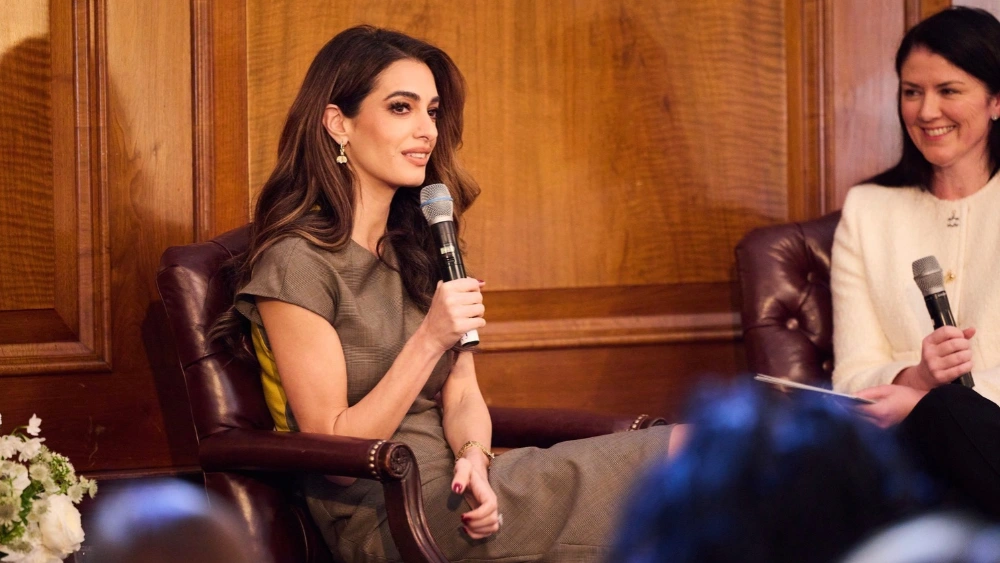
Human rights lawyer Amal Clooney spoke at a Harvey event in London on Monday about AI’s potential to widen access to legal advice.
Harvey COO Katie Burke said the company plans to step up its focus on governments and courts in 2027 as legal AI expands beyond private practice.
Harvey is looking to expand its work with governments and courts as it explores how AI could help tackle the gap between demand for legal assistance and the resources available to provide it.
The legal AI company expects the public sector to become a bigger focus in 2027, chief operating officer Katie Burke told Non-Billable, as the technology moves beyond the commercial law firms that have driven its adoption.
The comments came after a London event hosted by Harvey on Monday, where human rights barrister Amal Clooney spoke to an all-female audience of GCs, law firm partners, innovation leaders and non-profit executives about how AI could help improve access to justice.
Clooney is a barrister at Doughty Street Chambers and previously worked as a litigation lawyer at Sullivan & Cromwell in New York.
How AI is changing pro bono
Clooney highlighted how many people around the world struggle to obtain legal assistance, with barriers ranging from low literacy levels to a lack of internet access.
Through the Clooney Foundation for Justice, which she co-founded with her actor husband George Clooney, she is already using AI to address some of these challenges, from voice technology for people unable to read to legal information available around the clock in local languages.
“AI was the accelerant we never had before,” Clooney said, describing how the technology is helping the foundation reach more people and connect them with pre-vetted lawyers offering pro bono representation.
“Ethics and fairness also means not leaving behind those who are most vulnerable,” she added, explaining that they are developing LLMs for low-resource languages where there is little commercial incentive.
Harvey's relationship with Clooney began through its connections with Oxford and law school partnerships.
Speaking to Non-Billable after the event, COO Burke said the company was looking to put its technology to work for social benefit.The company recently established a global responsible business team based in London, headed by Christopher Hook, who previously worked on sustainability strategy at Accenture and Uber.
“If we talk about AI as having incredible power, we also have to be thoughtful about the responsibility we have to the world and to society,” Burke said.
Several attendees in the room also expressed interest in offering pro bono support and finding ways to get involved.
The pro bono push
Demand for free legal advice is rising. Clinics across England and Wales received more than 106,000 enquiries in 2025, up 17.5% on the previous year, according to charity LawWorks.
Corporate legal teams are also stepping up. Lloyds, Goldman Sachs and HSBC are among 25 companies signed up to the UK's In House Pro Bono Pledge.
Legal AI companies are also looking to play a role. Harvey recently launched a pro bono programme in the UK, US and Australia, working with Ashurst Perkins Coie, DLA Piper and Nelson Mullins to develop AI tools for high-volume legal work, including housing support and social welfare claims.
Burke said the company had deliberately started with three law firms across three markets, rather than attempting a much larger rollout before establishing what works for the organisations involved.
“We would rather have a broader impact on people who really need access to justice than rush to roll out a programme that doesn't actually work for the people who need it most,” she said.
Governments come into focus
The push into access to justice is also opening up another market for legal AI companies: governments and judicial systems.
Pressure on courts has never been greater. In England and Wales, the Crown Court backlog reached 80,829 cases in June, while magistrates' courts faced a new peak of more than 380,000 outstanding cases. Internationally, India's courts have more than 54 million pending cases, while Brazil ended 2025 with more than 75 million.
Burke pointed to Singapore as an example of a government willing to experiment with legal AI. Harvey has worked with the Singapore Judiciary since 2023, developing AI tools for its Small Claims Tribunals, where people represent themselves without lawyers.
The partnership has introduced document translation into Chinese, Malay and Tamil, alongside AI-generated case summaries to help court users and magistrates navigate proceedings.
In Australia, Harvey has completed an independent security assessment and secured a place on a New South Wales government procurement scheme, paving the way for wider public-sector adoption.
Harvey is not alone in identifying the opportunity. Rival Legora has also been expanding its focus beyond law firms, recently bringing in a former government minister to help develop its relationships with governments and public institutions.
“I think that's going to be a vertical we end up spending more time on in 2027,” Burke said.
Join 10,000+ City law professionals who start their day with our newsletter.
The essential read for commercially aware lawyers.